

The weather cools, the leaves turn, and suddenly your dog is licking her paws again or your cat is grooming a bare patch on his belly. If that sounds familiar, you are in good company. Fall allergies in dogs and cats are one of the most common reasons families reach out to me each October.
October is National Pet Wellness Month, an observance the American Veterinary Medical Association helped launch in 2004 to encourage regular wellness exams.[1] It is a fitting time to look at the skin, because autumn brings its own set of triggers, from late-season weed pollen to mold in damp leaves.
In this guide I will explain why fall allergies in dogs often flare now, what the signs look like in dogs and in cats, and how I think about itch from a root-cause and Traditional Chinese Veterinary Medicine (TCVM) perspective. You will also find simple habits you can start this week, and clear signs that it is time to see your veterinarian. None of these steps replace your veterinarian's care. They work best when you are doing both, side by side.
What causes fall allergies in dogs and cats? Many itchy pets are reacting to environmental allergens such as weed pollens, molds, and dust mites.[4][5] In autumn, ragweed pollen and mold from damp leaf litter are common seasonal triggers, and more time indoors can add dust mites to the mix.[2][3] Your veterinarian can help confirm what is driving the itch, and the home habits in this guide work best alongside their care.
-
Why Fall Allergies in Dogs Flare in Autumn
-
What Seasonal Allergies Look Like in Dogs and Cats
-
The Root-Cause View: Skin, Gut, and Immune Balance
-
The TCVM View: Autumn and the Metal Element
-
Home Habits That Support Your Pet's Skin This Fall
-
Nutrition Support for Itchy Skin
-
Working With Your Veterinarian
-
A Case From My Practice
-
Where to Start This Week
-
Frequently Asked Questions
-
References
Why Fall Allergies in Dogs Flare in Autumn
Veterinarians call environmental skin allergy "atopic dermatitis," or atopy. Cornell University's Riney Canine Health Center lists pollens, molds, dust mites, and dander among the typical triggers.[5] Cornell also notes that many cases are seasonal at first, and that symptoms can become year-round over time.[5]
Autumn stacks several of those triggers together.
- Weed pollen. The Asthma and Allergy Foundation of America describes ragweed season as running from August until the first hard frost, often peaking in mid-September.[2]
- Outdoor mold. Mold grows well in damp piles of fallen leaves, and a Northeastern University pharmaceutical scientist notes that mold allergies can continue after the first frost, when ragweed has finished.[3]
- Indoor allergens. As windows close and pets spend more time inside, household dust mites and dander take a bigger share of the load.[5]
Most of that research on pollen and mold timing comes from human allergy work, since the pollen season itself is the same for everyone in the house. Your dog, who walks nose-first through the leaves, simply gets a closer dose.
A longer, warmer fall can mean a longer pollen season. A 2024 Northeastern University report cites U.S. EPA data showing the ragweed season has grown longer at most monitored locations in the U.S. and Canada since 1995.[3]
What Seasonal Allergies Look Like in Dogs and Cats
In dogs
Itch is the hallmark sign. The Merck Veterinary Manual lists the paws, face, ears, the folds of the front legs, the armpits, and the belly as the areas most often affected.[4] At home, that tends to look like:
- Licking or chewing the paws, sometimes with rust-colored fur from saliva
- Rubbing the face on the carpet or furniture
- Scratching or shaking the ears
- Red skin on the belly or in the armpits
Merck also notes that signs can be seasonal, year-round, or year-round with seasonal flares.[4] A dog who is mildly itchy all year and much itchier every October fits that last pattern.
In cats
Cats can be harder to read, because many of them groom in private. Merck describes several patterns in cats with environmental allergies, including small crusty bumps along the back and neck (called miliary dermatitis), overgrooming that leaves symmetrical thin or bare patches on the belly and hind legs, and intense itching around the head and neck.[6] Like dogs, cats can show signs seasonally or all year.[6]
Please book a visit if you notice open sores, hot spots, a smell or discharge from the ears, sudden hair loss, sneezing or wheezing in a cat, or itch that is disrupting your pet's sleep. Fleas, food reactions, and skin infections can look a lot like seasonal allergy, and your veterinarian can help sort out which is which.
The Root-Cause View: Skin, Gut, and Immune Balance
In my practice, I look at an itchy pet as one whole animal with a story, and I rarely see the skin as the whole story. The skin is the barrier we can see. Behind it sit the immune system, which decides what to react to, and the gut, where a large share of immune activity is trained.
A 2024 review in Animal Frontiers describes the byproducts of gut bacteria as a common thread linking digestion, immune function, and behavior in dogs and cats.[7] That does not mean every itchy pet has a gut problem. It does explain why I ask about stool quality, appetite, and diet history at every allergy visit. We explored this more in the gut-immune connection.
I also think in terms of total load. Picture a bucket. Pollen adds a little, fleas add a little, a stressful month adds a little, and an ultra-processed diet may add a little more. Many pets cope fine until the bucket overflows, which is often when you see the itch. Lowering what goes into the bucket, from several directions at once, is the heart of a root-cause plan.
Spay and neuter history
I also ask every family about spay and neuter history. After the ovaries or testes are removed, the brain keeps sending luteinizing hormone (LH), with nothing left to answer it. A 2020 review in Animals by Dr. Michelle Kutzler of Oregon State University reports that LH levels in spayed and neutered dogs can run more than thirty times higher than in intact adult dogs.[8] The same review notes LH receptors in the thyroid and adrenal glands, the gut, and lymphocytes, a type of immune cell.[8]
Dr. Kutzler is careful to call the link to long-term health problems possible rather than proven, and the research so far is in dogs.[8] In my practice, surgical history is one more layer I weigh in the bucket, alongside the thyroid, the gut, and the skin. If your pet is already spayed or neutered, there is nothing to feel guilty about. This is simply one more piece of the whole picture.
When a family tells me the itch "came out of nowhere" in October, I look at the timeline first. What changed in the last few months? New food, a move, a round of antibiotics, a new cleaning product, a flea lapse? The answer often sits in the story.
The TCVM View: Autumn and the Metal Element
In Traditional Chinese Veterinary Medicine, each season is linked with one of five elements. Autumn belongs to Metal, which is associated with the Lung and the Large Intestine. In TCVM tradition, the Lung is also said to govern the skin and coat, and to support Wei Qi, the body's outer defensive energy.
That gives an old and useful lens for fall allergies in dogs and cats. When the Lung and Wei Qi are seen as out of balance, TCVM practitioners often describe dry skin, a dull coat, itch, or sensitivity to wind and change. The Large Intestine pairing is one more reason I pay attention to digestion in the autumn.
Some pets also carry a Metal constitution: often orderly, a little reserved, and sensitive to change in routine. These pets can find the shift of season a bit harder. TCVM is a traditional framework rather than a lab test, and I use it alongside a conventional exam, not in place of one.
Home Habits That Support Your Pet's Skin This Fall
Small habits, repeated, tend to matter more than any single product.
- Wipe paws and belly after walks. A damp cloth can remove pollen and mold spores before your dog licks them off. This is a gentle habit, and it takes about a minute.
- Ask your veterinarian about bathing. Merck notes that weekly to every-other-week baths can lower the allergen load on the skin.[4] Your veterinarian can suggest a gentle shampoo that fits your pet's skin.
- Wash bedding weekly in hot water. Bedding collects dander, dust, and pollen from every nap.
- Keep windows closed at night during high pollen weeks. This is advice given for people with ragweed and mold allergy, and it applies to the whole household.[3]
- Skip the leaf pile. It is tempting, and it is also where mold grows best.[3]
- Keep indoor spaces dry. Fix damp spots and ventilate bathrooms, since indoor mold favors moisture.[3]
It also helps to look at what your pet breathes and touches at home. Scented sprays, plug-ins, and harsh floor cleaners can irritate sensitive skin and airways. Our guide to common household toxins walks through the usual suspects, and these lifestyle habits round out the immune picture.
Nutrition Support for Itchy Skin
Omega-3 fatty acids
Omega-3 fatty acids are among the most common nutrition tools for itchy skin. It helps to set expectations. Merck notes that essential fatty acids are not useful for calming an acute flare, and that they can take up to two months to show their effect.[4] Cornell describes them as supplements used alongside other therapies.[5]
That fits how I use them: as a steady background layer, started well before allergy season when possible. I prefer omega-3 oil from small cold-water fish. Plant sources such as flaxseed provide a form that dogs and cats convert poorly into the omega-3s the skin uses, so I do not rely on them for this purpose.
Whole food and gentle changes
In my practice, I often see skin improve once a pet moves from an ultra-processed diet toward fresh, whole food. This is clinical observation rather than a controlled study, and every pet is different. If you try a diet change, go slowly over one to two weeks, change one thing at a time, and keep a simple log of itch, stool, and coat. For more on diet, herbs, and supplements, see our post on natural anti-inflammatory support.
Considering an omega-3 or a seasonal support formula?
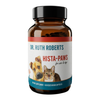
Please check with your veterinarian first, especially if your pet takes medication or has a health condition. If they are comfortable with it, you can explore Omega Pawz, the fish-based omega-3 oil I use, or Hista Paws, a quercetin-based formula I often include in seasonal plans.
Explore Omega Pawz Explore Hista PawsWorking With Your Veterinarian
A root-cause plan works best with a clear diagnosis underneath it. Your veterinarian can check for fleas, skin infection, ear infection, and food reactions, and can talk with you about allergy testing if the itch returns year after year.
Many itchy pets also need relief right now. Cornell lists several conventional options, including medicated shampoos, oral and injectable medications, and allergen immunotherapy.[5] There is a real place for these tools, especially when a pet is uncomfortable or has broken skin.
If your pet takes an allergy medication, please keep it in place and talk with your veterinarian before making any change. The habits in this article are meant to sit alongside your veterinarian's plan. We looked at the bigger picture in itch relief beyond Apoquel and Cytopoint.
Where to Start This Week
You do not need to change everything at once with fall allergies in dogs or cats. Pick one or two steps and build from there.
- Book a wellness visit. National Pet Wellness Month is a good reason to get a skin and ear check on the calendar.
- Start a paw-wipe routine. After every walk, especially on damp or windy days.
- Wash the bedding. Once a week, in hot water.
- Keep a two-week log. Note itch, licking, stool, and appetite. Patterns help your veterinarian and your coach.
- Ask about omega-3s. If your veterinarian agrees, starting now gives them time to build up.
Want to feel ready if a skin problem flares?
Our free Pet First Aid Checklist covers what to keep on hand at home and when a problem calls for your veterinarian right away.
Get the Free Pet First Aid ChecklistWant a plan shaped around your own pet?
Book a consultation with a Certified Holistic Pet Health Coach. In our coach directory, you can filter by dog or cat and by specialty. Coaches work alongside your veterinarian and do not diagnose or replace veterinary care.
Book a Coach ConsultationKeep learning alongside other pet parents.
This month in Pet Guardian Circle, we are focusing on autumn resilience: skin, weight, and gut health, with live Q&A sessions along the way.
Join Pet Guardian CircleCurious about helping other families with itchy pets?
In our Holistic Pet Health Coach certification, the Skin and Integumentary module covers the root causes of chronic skin conditions and the TCVM understanding of skin and ear problems. You learn to work alongside your clients' veterinarians, with weekly live coaching calls, personal mentors, and real case studies.
Explore the HPHC Certification-
Your Pet's Immune System Starts Here: The Gut-Immune Connection
-
The Apoquel/Cytopoint Trap: Why Long-Term Itch Relief May Need a Bigger Plan
-
Small Changes, Big Immune Wins: The Lifestyle Habits That Support Your Pet's Immune System
-
Cool the Fire: Why Chronic Inflammation Is Sabotaging Your Pet's Immune System
Frequently Asked Questions
Can dogs get seasonal allergies in the fall?
Yes. Environmental allergies in dogs can be seasonal, year-round, or year-round with seasonal flares.[4] In autumn, ragweed pollen and mold from damp leaves are common triggers, and ragweed season can run until the first hard frost.[2][3]
How can I tell if my cat has allergies?
Watch for overgrooming that leaves thin or bare patches on the belly or hind legs, small crusty bumps along the back, or scratching around the head and neck.[6] These signs overlap with fleas and other skin problems, so a veterinary exam is the best next step.
Should I stop my dog's allergy medication if I start these habits?
No. Keep any medication your veterinarian prescribed, and talk with them before making changes. These habits work alongside medication, not instead of it.
How long do omega-3s take to help itchy skin?
Merck notes that essential fatty acids can take up to two months to show their effect, and they are not meant for calming an acute flare.[4] That is why I suggest starting them early, with your veterinarian's approval.
| [1] | American Veterinary Medical Association. "October is National Pet Wellness Month." JAVMA News, October 1, 2004. avma.org/javma-news/2004-10-01/october-national-pet-wellness-month (News report on the launch of the observance.) |
| [2] | Asthma and Allergy Foundation of America. "Ragweed Pollen Allergy," last modified August 19, 2026. aafa.org/allergies/types-of-allergies/pollen-allergy/ragweed-pollen (Human allergy organization. Used only for the timing of ragweed season.) |
| [3] | Hibbert CM. Article on the 2024 fall allergy season, quoting Mansoor Amiji, PhD. Northeastern Global News, October 3, 2024. news.northeastern.edu/2024/10/03/fall-allergies-2024 (University news article. Used for mold, ragweed season length, and household tips. Human-focused.) |
| [4] | Hoff S. "Atopic Dermatitis in Dogs." Merck Veterinary Manual, updated May 2026. merckvetmanual.com/integumentary-system/atopic-skin-conditions-in-dogs-and-cats/atopic-dermatitis-in-dogs |
| [5] | Collins B. "Atopic dermatitis (atopy)." Riney Canine Health Center, Cornell University College of Veterinary Medicine, updated October 21, 2025. vet.cornell.edu/departments-centers-and-institutes/riney-canine-health-center/canine-health-topics/atopic-dermatitis-atopy |
| [6] | Hoff S. "Feline Atopic Skin Syndrome." Merck Veterinary Manual, updated May 2026. merckvetmanual.com/integumentary-system/atopic-skin-conditions-in-dogs-and-cats/feline-atopic-skin-syndrome |
| [7] | Rindels JE, Loman BR. "Gut microbiome, the key to our pets' health and happiness?" Animal Frontiers, 2024;14(3):46-53. doi.org/10.1093/af/vfae015 |
| [8] | Kutzler MA. "Possible Relationship between Long-Term Adverse Health Effects of Gonad-Removing Surgical Sterilization and Luteinizing Hormone in Dogs." Animals, 2020;10(4):599. doi.org/10.3390/ani10040599 |
This information is for educational purposes and is not a substitute for personalized veterinary care. Always consult your veterinarian before making changes to your pet's health routine. Natural remedies are not automatically risk-free, and any new supplement or diet change is best introduced gradually and with your veterinarian's guidance.